Center for Conflict Resolution: A Website Analysis

It is important to understand when it is beneficial and when it is harmful to invite uninvolved individuals to join a conflict.  If outside individuals are being utilized in order to form coalitions or conflict triangles, then this action will not lead to long-term solutions nor will it resolve the issues at hand.  Conflict triangles, as defined by Joyce Hocker and William Wilmot in their textbook, Interpersonal Conflict, are coalitions that are created in response to people holding low-power positions within their conflict.  While triangles are common and sometimes beneficial, they can also be harmful.  The formation of coalitions ultimately create in-groups and out-groups.  The formation of these groups can negatively impact the likelihood that issues will be resolved, as it turns individuals or groups against each other, rather than allowing them to focus on the issues that need addressed (Hocker & Wilmot, 2011, p. 229-234). 

Involving outside individuals in conflicts can prove to be very helpful, however.  Mediation is sometimes an important factor in conflict resolution.  If two parties cannot truly communicate or resolve their issues on their own, skilled mediation is appropriate and necessary.

Using a skilled third party can help to create healthy conflict styles for individuals, recognize compatible goals between parties, create a power balance, expand the actual or perceived scarcity of resources, and so much more!  We feel that the work done by the Center for Conflict Resolution (CCR) in Chicago, established in 1979, is a great example of a skilled third party.  Let’s take a look at their mission statement from their website.
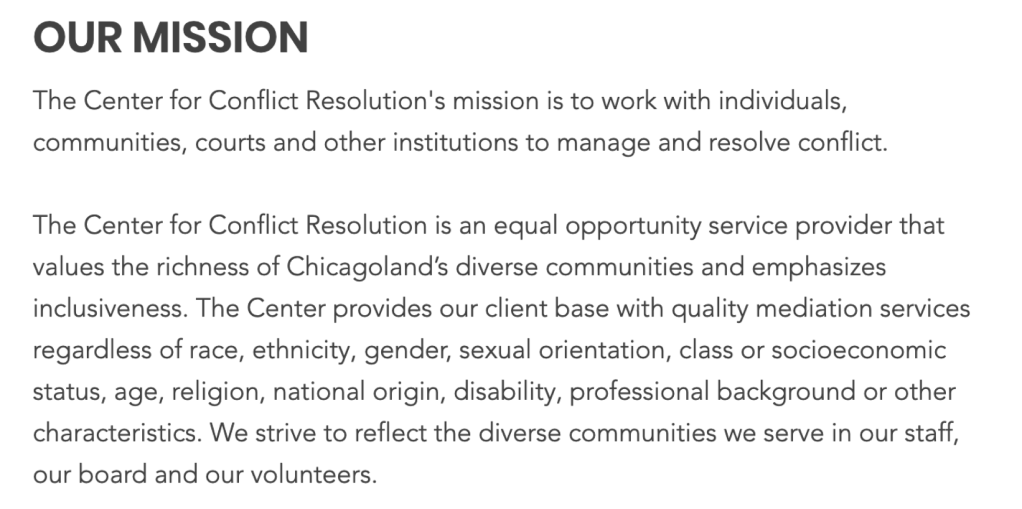
The Center for Conflict Resolution in Chicago does a remarkable job at recognizing the perceived power differences between individuals based on their age, race, income, education, disability, gender, etc.  CCR works to balance these power differences, so that long-term resolutions can be found between diverse individuals or groups. 
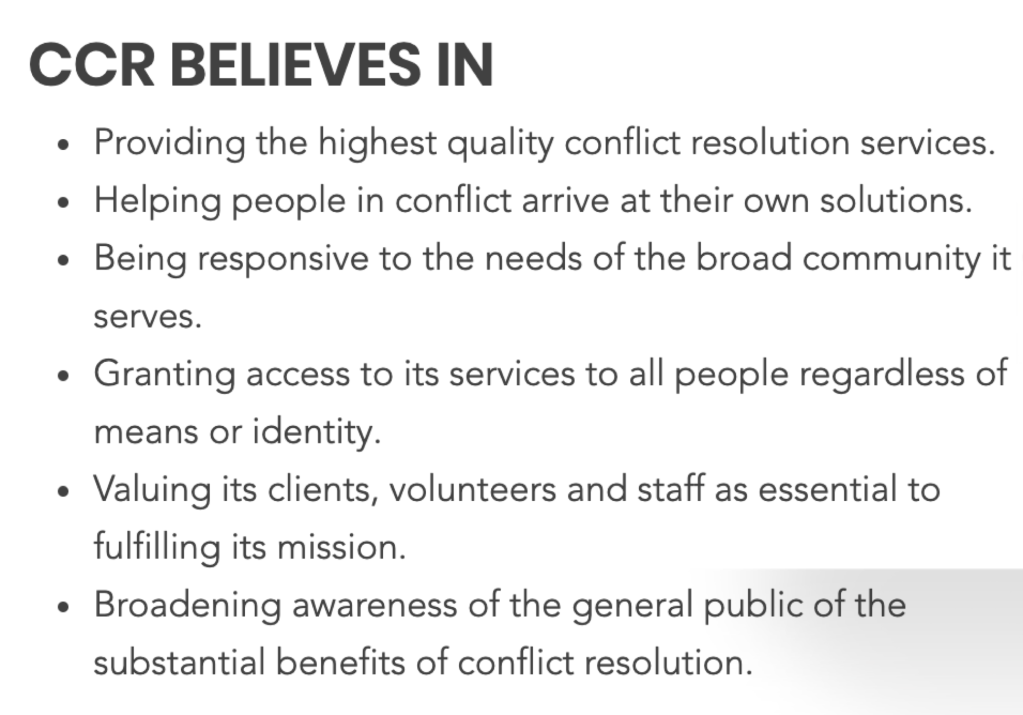
We also believe that the CCR is an effective resource for those in conflict, because they value the action of aiding others in arriving at their own solutions, rather than resolving their issues for them.  They act as a middle party, rather than as a judge.  This is important to recognize, because their work allows people in conflict to create long-term solutions for themselves and their own personal relationships.  They can use the techniques and skills displayed by CCR employees to aid their conflicts in the future. 

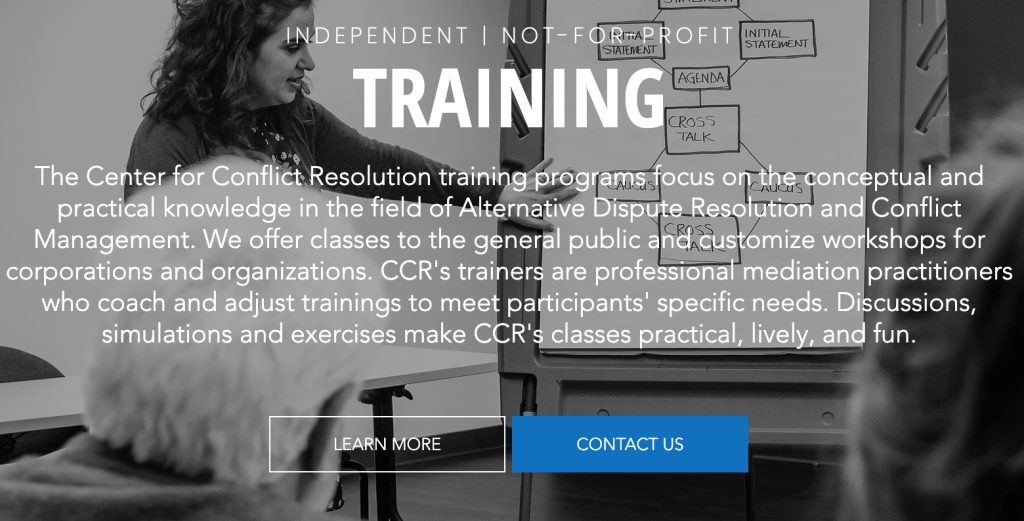
Furthermore, the CCR also values conflict resolution advocacy, as they reach out to other organizations within the Chicago community to offer conflict management workshops and other training programs.  They offer multiple online and in-person courses for those who wish to truly learn the art of mediation or integration negotiation.  They are a non-profit, private institution that is solely focused on giving aid to those in their community.

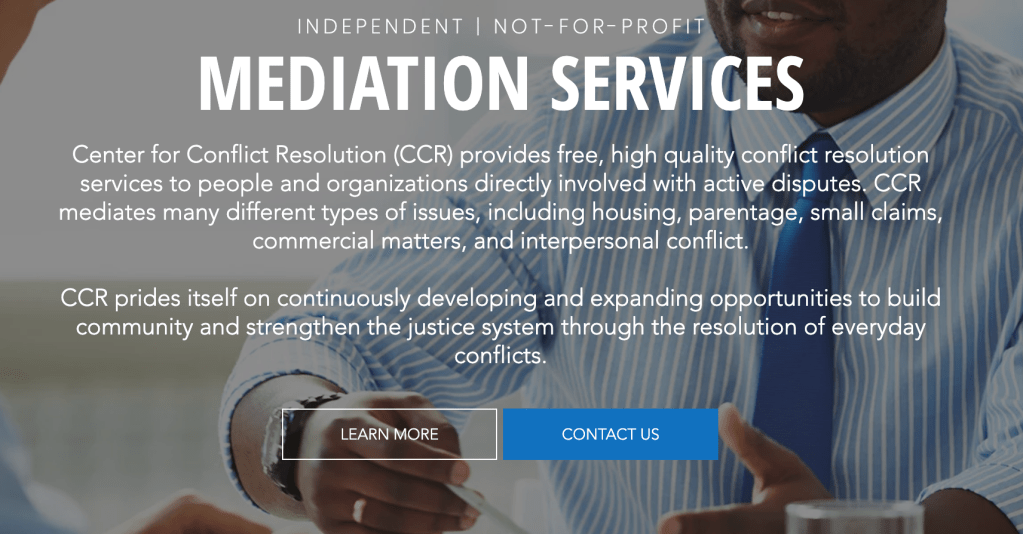
The CCR serves more than 5,000 clients each year and offers more than 20 mediation programs that handle evictions, foreclosure, and family disputes in the Chicago area. The CCR also trains more than 500 individuals each year in mediation, conflict management, and communication skills. After taking a look into the Center for Conflict Resolution’s blog that offers client testimonials on the aid they received from the CCR, it is clear that their work is impactful and long-lasting.
Their website is very easy to navigate and all of the center’s contact information is listed at the bottom of each webpage. The CCR’s participation in the Chicago community has been increasing over the years and it will be enlightening to see where the organization’s work will take them in the future.

References 
Center for Conflict Resolution. (2019). About CCR.Center for Conflict Resolution. Retrieved from https://www.ccrchicago.org/
Hocker, J.L., & Wilmot, W.W. (2011). Interpersonal conflict. New York, NY: McGraw-Hill Education.

A Frank Ocean Skit Conflict Analysis

Christopher Francis Ocean, more commonly known as Frank Ocean, is an American singer-songwriter from Long Beach, California born in 1987.  As a young teen, he moved to Los Angeles to jumpstart his career in music.  He soon became a writer for major pop stars, such as Justin Bieber and Beyoncé.  It was not until 2011, however, that he began to produce his own music.

In 2016, Frank Ocean released his second album, Blonde.  The album is particularly interesting in that it includes two short skits along with fifteen other songs.  One of the skits, titled Be Yourself, offers advice to young adults struggling with peer pressure and the abuse of drugs and alcohol.  The skit is recorded to sound like a voicemail in the voice of Frank Ocean’s mother.  The purpose of the skit is to draw attention to modern day pressures faced by teenagers and young adults.

The second skit also deals with modern day pressures, but involves the use of social media.  The skit, titled Facebook Story, is a voice recording of Ocean’s friend and collaborator, SebastiAn.  This skit will be analyzed to give a deeper understanding of the conflict that occurs between SebastiAn and his partner, as well as to determine how the conflict could have been better managed by the couple.  

Please listen to the following link to Frank Ocean’s, Facebook Story.

The following lyrics, provided by Genius Media Group, are provided as well to better aid this analysis:

            I was just telling that I got this girl before

            And I was together since 3 years

            And I was not even cheating her or what

            And Facebook arrived and

            She wanted me to accept her on Facebook

            And I don’t want it because I was like in front of her

            And she told me like “Accept me on Facebook”

            It was virtual, means no sense

            So I say, “I’m in front of you, I don’t need to accept you on Facebook”

            She started to be crazy

            She thought that because I didn’t accept her

            She thought I was cheating

            She told me like, “It’s over, I can’t believe you”

            I said, “Come on, you’re crazy, because like, I’m in front of you, I’m every day, here in your house”

            That’s, it means like it’s jealousy

            Pure jealousy for nothing

            You know, virtual thing

After listening to the skit and reading the dialogue, one can acknowledge that there are many dimensions of conflict in just this one-minute production.  On the surface, it is clear that SebastiAn and his partner have differing opinions on social media, specifically Facebook.  SebastiAn does not find importance in “friending” people on social media if he has an in-person relationship with them.  His partner, however, feels that SebastiAn’s reluctance to make their relationship public makes him secretive and unfaithful.   

As explained by Joyce Hocker and William Wilmot in their textbook, Interpersonal Conflict, there is always more than one goal at play during a conflict.  The act of friending a person on Facebook, or not, is a topic goal.  Topic goals, as defined by Hocker and Wilmot, “emerge as different ideas about what to do, what decisions to make, where to go, how to allocate resources, or other externally objectifiable issues” (2011, p. 75).  It is clear that this couple’s topic goals are not the same.  Along with topic goals, which are the easiest to distinguish, there are also relational goals, identity or face-saving goals, or process goals at play within all conflicts. If you look further into the scenario explained by SebastiAn, one can further understand the roles of relational and identity goals in his conflict (Hocker & Wilmot, 2011, p. 77-80).

Relational goals “define how each party wants to be treated by the other” and “how they define themselves as a unit” (Hocker & Wilmot, 2011, p. 77).  The couple has different relational goals in terms of their social media use and how they want to be treated by their partner on social media.  SebastiAn’s partner felt disrespected in his refusal to accept her friend request on Facebook.  She not only wants their relationship to exist in the physical world, but she wants it to be present in the virtual world as well.  She feels that making their relationship public is important when it comes to defining the strength and sense of mutuality of their relationship. 

SebastiAn, however, does not view a virtual relationship as being pertinent in defining the strength of their physical relationship.  He feels that his partner is acting “crazy,” because she places such emphasis on extending their relationship to the virtual realm.  SebastiAn feels that their relationship is defined based on their in-person interactions.  He states, “I’m every day, here in your house” (Genius Media Group, 2019).  Both partners agree that they are a unit, but they differ on how they wish to be treated.

Furthermore, the couple’s identity goals also come into play in their conflict.  As described by Hocker and Wilmot, identity goals “include specific desires to maintain one’s sense of self-identity” (2011, p. 81).  When a person’s identity goals are threatened, they tend to become highly defensive, or even destructive, in the conflict.  Identity goals are harder to distinguish, but it is arguable that SebastiAn’s partner’s identity goals were threatened throughout their conflict.  This ultimately led her to leave the relationship stating, “It’s over, I can’t believe you” (Genius Media Group, 2019).

When SebastiAn refused to accept the Facebook friend request, his partner felt a loss of face. It is unclear if SebastiAn outwardly called his partner “crazy,” but his emotions and sense of disproval were ultimately sensed by his partner.  She did not feel that her request was crazy in any form, so her sense-of-self was threatened.  Furthermore, her conclusions that SebastiAn may have been cheating could have also led to a loss of face.  As previously explained, when our sense-of-self is threatened, we are likely to act abruptly or destructively in our conflicts.  That is why SebastiAn’s partner chose to end the relationship. 

It is sometimes difficult to distinguish when our actions will lead to a loss of face for others, but the results may be irreversible.  In terms of the conflict present in Frank Ocean’s Facebook Story, SebastiAn’s partner’s loss of face was irreversible and completely destructive to the relationship.  After this analysis, we hope that our readers can understand that not all conflicts are as simple as they may seem.  Topic goals are always driven by deeper, more personal goals.  If SebastiAn and his partner would have been more transparent in describing these underlying goals, then their relationship possibly could have been saved.  We hope that this analysis enlightens our readers to take a closer look into their conflicts and look for these hidden goals, both within themselves and within those who they conflict with.  Until these goals are addressed, no conflict will ever be truly resolved.

References
Akchote-Bozovic, S., & Ocean, C. F. (2016). Facebook Story. On Blonde [CD]. London: Abbey Road Studios.  
Blonded. [Blonded]. (2017, July 6). Facebook story. [Video file]. Retrieved from https://www.youtube.com/watch?v=_2xgmbgCtM8
Genius Media Group. (2019). Facebook story lyrics. Genius Media Group, Inc. Retrieved from https://genius.com/Frank-ocean-facebook-story-lyrics
Hocker, J.L., & Wilmot, W.W. (2011). Interpersonal conflict. New York, NY: McGraw-Hill Education.

Inside Out: Destructive Dinner Conflict


This clip shows a dinner scene from the Pixar movie Inside Out. The light and topical conversation quickly turns into an interaction full of raised voices and charged negative emotions.


In this scene, Riley responds to her mother’s excited comment regarding a local hockey team with, “Oh that sounds fantastic,” which is a sarcastic remark. According to Hocker and Wilmot, this can be described as contempt because Riley is mocking her mother’s suggestion in order to put herself on a higher plane (Hocker & Wilmot, 2011, p. 27).


While watching this clip I encourage you as the viewer to look at how Riley’s use of contempt right off the bat signals emergency to her mother.


Riley then responds to her mother’s inquiry about school with “um it was fine I guess …I don’t know,” which shows her lack of cooperation. After this moment, an escalatory spiral/ spiral of negativity begins marked by the sequence of behaviors from all parties at the table. Consequently, the relational quality is compromised. Riley responds to her mother’s inquiry about school with “um it was fine I guess …I don’t know,” which shows her lack of cooperation. Her mother then calls in for back up from the father.


Next, Riley rolls her eyes which perpetuates the spiral of negativity even further because that is an attack on the face of her father. He perceives that Riley’s behavior towards him is not acceptable because he is her father. Behaviors, perceptions of the other, and perceptions of the relationship is what causes the cascade of negative effects (Hocker & Wilmot, 2011, p. 33). He signals to Riley that her behavior is not acceptable by saying “I do not like this new attitude.” As a result, the interaction becomes laden with emotion causing the exchange to become damaging. This video uses siren sound effects to show the escalation in emotion which eventually leads Riley to tell her father to “shut up.” 


We see in this video that escalatory conflicts have only one direction, and when the relationship keeps circling around damaging ends, destruction is bound to occur. The escalation was caused by the absence of direct communication and the presence of avoidance and contempt. 


At the end of the movie, it is revealed that Riley was using contempt as a way to save face (Hocker & Wilmot, 2011, p. 80). When she was finally honest with her parents, it is apparent that when she moved she was stripped away from her friends, school, sports, and other things that constitute her identity. By using “I” statements Riley was able to communicate why she was so upset since they moved. After communicating her true her parents were able to give her support. 


Riley’s parents could have reasoned with her better in the first clip by softening contempt and refusing to engage in destructive communication. When she was being disrespectful her father could have responded with something like, “I will not let you speak to me like this,” or  “This conversation is not working I am going to stop talking with you.” Disengagement plays a key role in preventing escalatory spirals (Hocker & Wilmot, 2011, p. 27).

 References

Hocker, J. L., & Wilmot, W. W. (2011). Interpersonal conflict. New York, NY: McGraw-Hill Education.

Inside Out. (n.d.). Retrieved from https://www.youtube.com/watch?v=Cjgdiy_SGjA

Design a site like this with WordPress.com
Get started